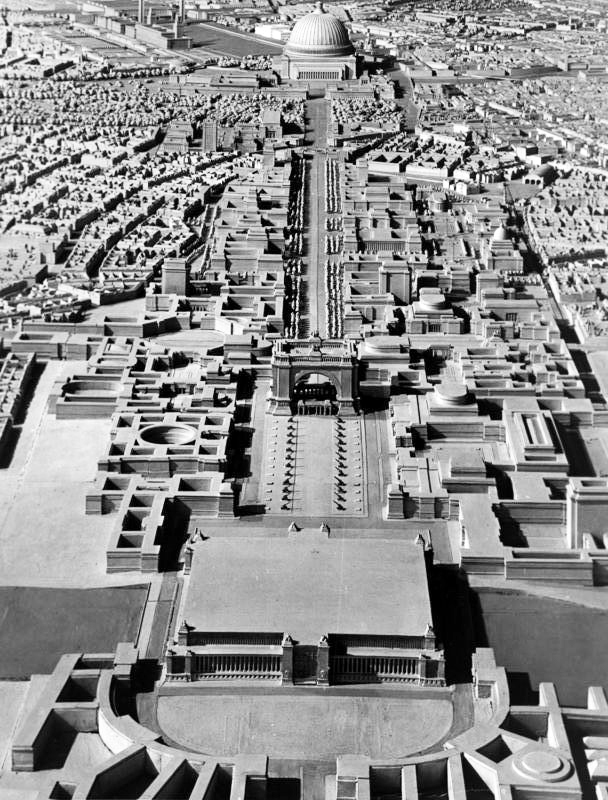
Germania (pronounced [ɡɛʁˈmaːni̯a]) was the projected renewal of the German capital Berlin, part of Adolf Hitler‘s vision for the future of Germany after the planned victory in World War II. Albert Speer, the “first architect of the Third Reich“, produced many of the plans for the rebuilt city in his capacity as overseer of the project, only a small portion of which was realized between the years 1938 and 1943 when construction took place.
Some of the projects were completed, such as the creation of a great East–West city axis, which included broadening Charlottenburger Chaussee (today Straße des 17. Juni) and placing the Berlin victory column in the centre, far away from the Reichstag, where it originally stood. Others, however, such as the creation of the Grosse Halle (Great Hall), had to be shelved owing to the beginning of war. A great number of the old buildings in many of the planned construction areas were, however, demolished before the war, and eventually defeat stopped the plans.
Name
It was Adolf Hitler who conceived of rebuilding Berlin to be the capital of the new world he would be instrumental in creating, and who provided the new name for it, ‘Germania’. According to records of Hitler’s “table talk” of 8 June 1942, Hitler’s purpose in the renaming was in order to give a Greater Germanic world empire of the New Order a clear central point:
Just as the Bavarians and the Prussians had to be impressed by Bismarck of the German idea, so too must the Germanic peoples of Continental Europe be programmatically steered towards the Germanic concept. He [Hitler] even considers it good that by renaming the Reich capital Berlin into ‘Germania’, we’ll have given considerable driving force to this task. The name Germania for the Reich capital would be very appropriate, for in spite of how far removed those belonging to the Germanic racial core will be, this capital will instill a sense of unity.

The Schwerbelastungskörper was built in order to determine whether the unconsolidated Berlin ground could support the weight of the planned triumphal arch.
Planning
Doubts persisted at the time as to whether the marshy Berlin ground could have taken the load of the proposed projects, leading to the construction of an exploration building (Schwerbelastungskörper, literal translation: heavy load-bearing body), which still exists near the site where the Arch of Triumph would have been built. It is basically an extremely heavy block of concrete used by the architects to test how much weight the ground was able to carry. Instruments monitored how far the block sank into the ground. The Schwerbelastungskörper sank 18 cm (7 1⁄8 in) in the three years it was to be used for testing, compared to a maximum allowable settlement of 6 cm (2 3⁄8 in). Using the evidence gathered by these gargantuan devices, it is unlikely the soil could have supported such structures without further preparation. The plan was to cover the Schwerbelastungskörper by building a bridge over it. The arch would have been near by, but problems with the axis running through infrastructure would have made it difficult to establish any convenient location.
Read more here at Wikepedia

The Volkshalle (“People’s Hall”), also called Große Halle (“Great Hall”) or Ruhmeshalle (“Hall of Glory”), was a huge domed monumental building planned by Adolf Hitler and his architect Albert Speer for Germania in Berlin. The project was never realized.
The word Volk had a particular resonance in National Socialist thinking. The term völkisch movement, which can be translated to English as “the people’s movement” or “the folkish movement”, derives from Volk but also implies a particularly racial undertone. Before the First World War, völkisch thought had developed an attitude to the arts as the German Volk; that is, from an organically linked Aryan or Nordic community (Volksgemeinschaft), racially unpolluted and with its roots in the German soil of the Heimat (homeland).
Read more here at Wikepedia
 Germanic Unity
One reply on “Germania”
Reblogged this on VikingLifeBlog.
LikeLike